 Navigation

Theoretical Astrophysics (MKTP2)
Sommersemester 2026
Dozent: Maturi Matteo
51 Teilnehmer/innen
Dozent: Maturi Matteo
51 Teilnehmer/innen
Theoretical Astrophysics
Lecturer:
Prof. Dr. Matteo Maturi (ITA/ZAH, ITP)
maturi@uni-heidelberg.de
Head tutors:
Yannic Pietschke: pietschke@thphys.uni-heidelberg.de
Vrund Patel: patel@thphys.uni-heidelberg.de
Space and time:
- Summer semester, 2026
- From 13.4.2026 to 22.07.2026
- Monday 11:15-13:00 (Philosophenweg 12 gHS)
- Wednesday 11:15-13:00 (Philosophenweg 12 gHS)
Overview:
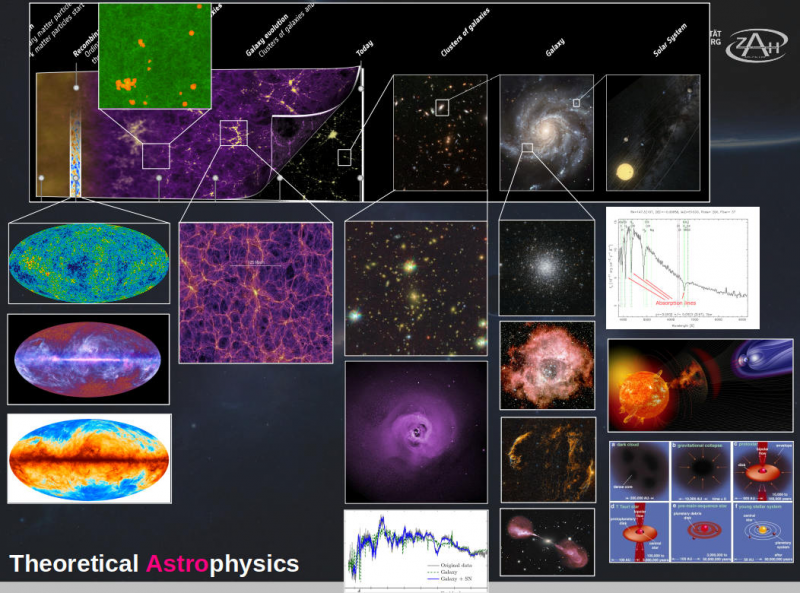
The lectures will cover a variety of topics that will allow the students to understand the physics involving celestial bodies such as planets, stars, nebulae, black holes, galaxies, galaxy clusters, etc.. The lectures and exercise classes are held in English.
Content:
- Basics: recap on basic concepts - Cosmology, Special relativity - Electrodynamics - Phase space and Planck spectrum
- Radiation processes: emission and absorbtion in the cosmos - Thompson and Compton scattering - Spectra (in general) and quantum transitions - Synchrotron and Bremsstrahlung - Radiation transport
- Hydrodynamics: how to deal with fluids - Ideal hydrodynamics - Viscous hydrodynamics - Examples and applications - shock waves and instabilities
- Plasma physics: how to deal with ionized gasses - Collisionless plasmas - Radiation in ionized media - Thermal plasmas - Magnitohydrodynamics
- Gravitation: concepts relevant for cosmology
- Stellar dynamics: the Jeans equations - The tensor virial theorem
- Gravitational wanders (bonus): New important windows in astrophysics - Gravitational lensing, dark matter mapping and black hole shadows - Gravitational waves and merging of black holes
Prerequisites:
Cosmology, PTP3 and PTP4 are helpful but not mandatory. Lectures will be self contained.
The lectures will be held in person. Recordings of the lectures will be availalbe. I will start slow to build up solid basis. The lectures and exercise classes are held in English. The tutorials will start one week after the main lectures.
Material:
Lecture notes covering the blackboard material and additional documents will be provided. The notes will be complementary to other material/books and present full mathematical derivations. You find everything in this page.
Literature:
Theoretical Astrophysics: an Introduction (Matthias Bartelmann)
Radiative processes in Astrophysics (Rybicki & Lightman)
Weak gravitational lensing (Matthias Bartelmann & Matteo Maturi)
Introduction to cosmology (Matteo Maturi)
Theoretical Astrophysics: an Introduction (Matthias Bartelmann)
Radiative processes in Astrophysics (Rybicki & Lightman)
Weak gravitational lensing (Matthias Bartelmann & Matteo Maturi)
Introduction to cosmology (Matteo Maturi)
Enrollment:
To get credit points for the lectures it is necessary to enroll through heiCO. If you are still missing the credentials (immatriculation, ID number, ...) and can not log-in, ask the head tutor to be enrolled manually
Script and exercises:
Additional material and the exercises will be added below and will be available for download.
Exam 1:
21st July 2026, Tuesday
14:00 - 17:00
Room: HS 2 (INF 227)
Admission to the exam:
Attend at least 70% of the tutorials AND gain 5 points in different tutorials by: Presenting an exercise (1 point) or actively participating in the discussion during the tutorials (max 1 point). If participation is below 70%, it is required to hand in 3 full exercise sheets (before their discussion during the tutorials) that will be graded.
Attend at least 70% of the tutorials AND gain 5 points in different tutorials by: Presenting an exercise (1 point) or actively participating in the discussion during the tutorials (max 1 point). If participation is below 70%, it is required to hand in 3 full exercise sheets (before their discussion during the tutorials) that will be graded.
Lehre, Studium und Forschung:
Lecture Token MKTP2 (8CP): heiCO
INDEX OF THE LECTURES:
Introduction - special relativity
- Introduction
- Special relativity, the concept
- Space-time, vectors and one-forms
- Lorentz geometry, Lie algebra of the Lorentz group (bonus material)
Behaviour of neutral particles
- Relativistic mechanics
- Particles in a gravitational field
Gravitation
- The most general non relativistic linear theory of gravity
- Newton-Cartan gravity
- General relativity in a nutshell
Behaviour of Charged particles - E.M. fields - Emission/absorption processes
- electrodynamics, constructing the theory
- charged particles in EM fields, Lorentz force, EM tensor
- electromagnetic field invariants
- charge density, continuity equation, gauge invariance
- electromagnetic field equations
- solution of the field equations
- energy-momentum tensors (closed systems)
- energy-momentum-tensor of electromagnetic fields and Larmor formula
- Special relativity, the concept
- Space-time, vectors and one-forms
- Lorentz geometry, Lie algebra of the Lorentz group (bonus material)
Behaviour of neutral particles
- Relativistic mechanics
- Particles in a gravitational field
Gravitation
- The most general non relativistic linear theory of gravity
- Newton-Cartan gravity
- General relativity in a nutshell
Behaviour of Charged particles - E.M. fields - Emission/absorption processes
- electrodynamics, constructing the theory
- charged particles in EM fields, Lorentz force, EM tensor
- electromagnetic field invariants
- charge density, continuity equation, gauge invariance
- electromagnetic field equations
- solution of the field equations
- energy-momentum tensors (closed systems)
- energy-momentum-tensor of electromagnetic fields and Larmor formula
- momentum of intensity
- spectrum of radiation
- applications Larmor formula: Thomson cross section, Eddington luminosity
- applications Larmor formula: synchrotron radiation
- applications Larmor formula: bremsstrahlung
- applications Larmor formula: Thomson cross section, Eddington luminosity
- applications Larmor formula: synchrotron radiation
- applications Larmor formula: bremsstrahlung
- radiation damping
- photons and Compton scattering
- phase-space, Planck spectrum
- astrophysical examples: emission from free charges, scattering, Planck spectrum
- quantum transitions
- shape of spectral lines
- stimulated emission and radiation transport
Behaviour of gas/fluids: hydrodynamics
- hydrodynamic equations
- polytropic eq. of state
- sound waves
- viscous hydrodynamics
- evolution of specific entropy
- vorticity and Raynolds-number
- Bernoulli's law
- a deepr look at fluids with gravitational fields
- transport mechanisms: thermal conduction, convection, tourbolence
- astrophysical applications: Bondi accreation, self gravitating systems
- hydrodynamic instabilities
- shock waves
Behaviour plasma and propagation of light in medium
- plasma physics
- electromagnetic waves in media
- the dielectric tensor and the phase space of particles
- e.m. waves in thermal plasma
- magnetohydrodynamics
Stellar dynamics
- stellar dynamics
Extra (if there is time)
- dark matter
- gravitational lensing
- cosmic microwave background
- conclusions
Additional material
- Theoretical Astrophysics, an introduction (M. Bartelmann)
- Cosmology (M. Maturi)
- Heidelberg Joint Astronomical Colloquium
- photons and Compton scattering
- phase-space, Planck spectrum
- astrophysical examples: emission from free charges, scattering, Planck spectrum
- quantum transitions
- shape of spectral lines
- stimulated emission and radiation transport
Behaviour of gas/fluids: hydrodynamics
- hydrodynamic equations
- polytropic eq. of state
- sound waves
- viscous hydrodynamics
- evolution of specific entropy
- vorticity and Raynolds-number
- Bernoulli's law
- a deepr look at fluids with gravitational fields
- transport mechanisms: thermal conduction, convection, tourbolence
- astrophysical applications: Bondi accreation, self gravitating systems
- hydrodynamic instabilities
- shock waves
Behaviour plasma and propagation of light in medium
- plasma physics
- electromagnetic waves in media
- the dielectric tensor and the phase space of particles
- e.m. waves in thermal plasma
- magnetohydrodynamics
Stellar dynamics
- stellar dynamics
Extra (if there is time)
- dark matter
- gravitational lensing
- cosmic microwave background
- conclusions
Additional material
- Theoretical Astrophysics, an introduction (M. Bartelmann)
- Cosmology (M. Maturi)
- Heidelberg Joint Astronomical Colloquium
Materialien
Übungsblätter
- 1
- 2
- 3
- 4
- 5
- 6
- 7
- 8
- 9
- 10
- 11
- 12
- Mock exam
Übungsgruppen
- Gruppe 1 (Suprio Dubey)
18 Teilnehmer/innen
Philosophenweg 12 SR 59, Mi 09:15 - 11:00 - Gruppe 2 (Stefano D'Amore)
15 Teilnehmer/innen
Philosphenweg 12 kHS, Fr 14:15 - 16:00 - Gruppe 3 (Franka Prahin)
14 Teilnehmer/innen
Philosophenweg 12 SR 59, Fr 09:15 - 11:00
